How do I migrate my Google Photos library to a NAS?
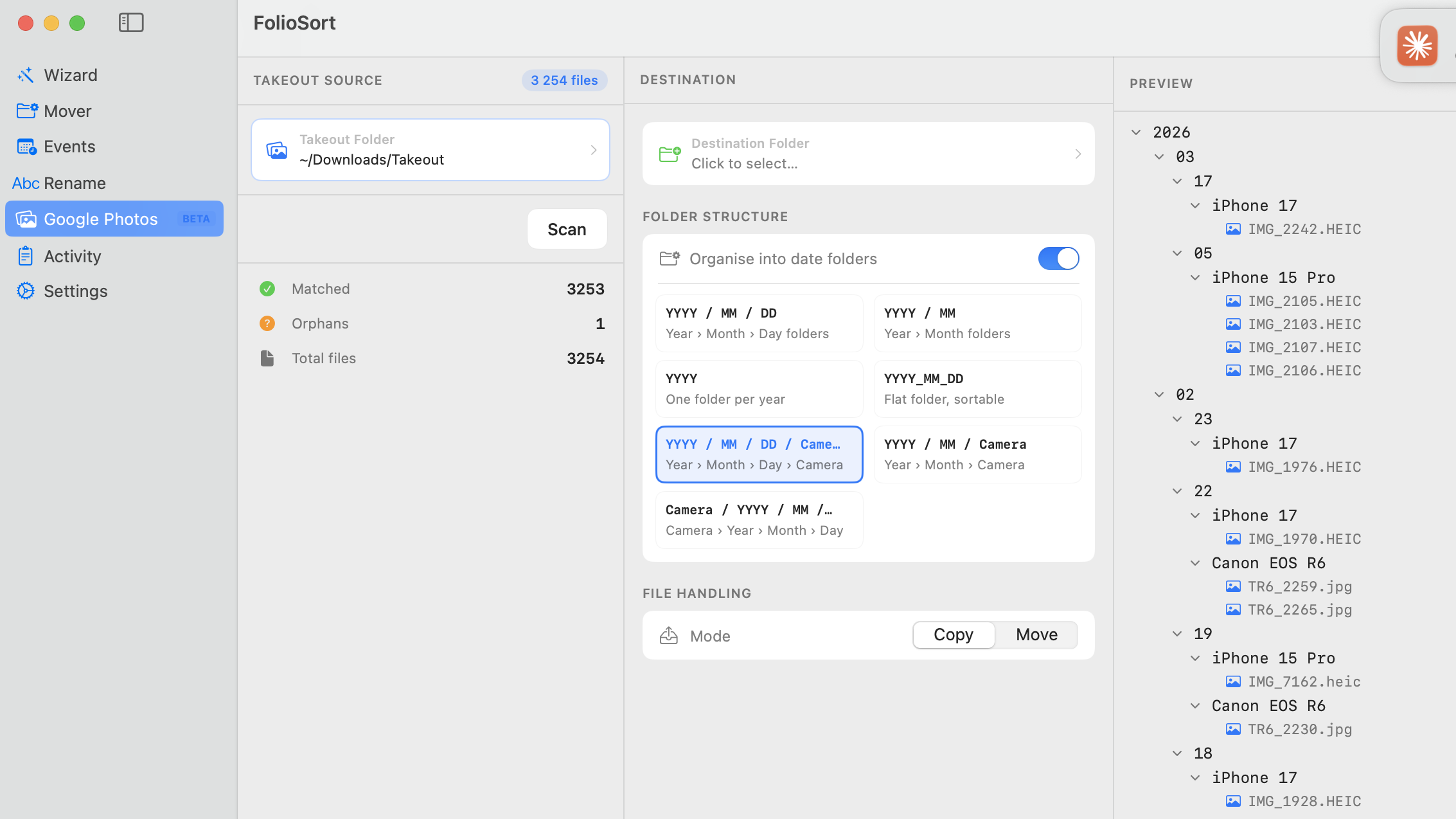
Export your photos with Google Takeout, extract the .zip files into one folder, then open FolioSort and select Google Photos (Beta) in the sidebar to restore the real dates and GPS from the JSON sidecars. Mount your NAS share in Finder with ⌘K (smb://your-nas-ip), set that mounted share as FolioSort's destination, and click Process to transfer your organized Year/Month library straight to the NAS. The full walkthrough is in the steps above.
Why do my Google Photos all show today's date after I copy them to a NAS?
Takeout stores the real capture date in separate .json sidecar files, not in the photo's EXIF. When your Mac extracts the zip it stamps every file with the extraction date, so copying straight to a NAS preserves that wrong date. FolioSort reads those sidecars and writes the correct DateTimeOriginal back into each file before the transfer — so the timeline is right on the NAS.
Is FolioSort free to migrate Google Photos to a NAS?
Yes. FolioSort is free to download and the free tier processes up to 100 files per operation, so you can test the entire workflow end to end. Pro (€19.99, one-time — no subscription) removes the limit for large libraries and adds duplicate detection.
Does FolioSort upload my photos to the cloud?
No. FolioSort runs 100% locally on your Mac or PC. It never uploads anything to a server or cloud — the only place your photos go is your NAS, transferred over your own local network to the SMB share you mounted.
Can I transfer straight to my SMB or AFP NAS share?
Yes. Mount the NAS share in Finder with ⌘K (smb://your-nas-ip or your hostname), and it appears as a normal volume. Set that mounted share as FolioSort's destination and it writes your organized Year/Month folders directly to the NAS, verifying each file with a checksum and retrying if the connection drops.
Which NAS brands does FolioSort work with?
Any NAS that can share a folder over SMB or AFP — which covers every modern device. That includes Synology, QNAP, WD My Cloud, TerraMaster, Asustor, Buffalo, Netgear and any custom Linux NAS. FolioSort writes to the mounted share, so it doesn't care about the brand.
Will FolioSort modify or risk my original Takeout files?
No. FolioSort uses a copy-then-verify approach: it copies each file to the NAS, verifies it with a checksum, and only removes the source if you explicitly choose Move. Your raw Takeout files stay untouched until you've confirmed the library on the NAS is correct.
Does this work on Windows too?
Yes — FolioSort runs on both macOS 14+ and Windows 10+, with the same Google Photos (Beta) import and folder organization. On Windows you map the NAS share as a network drive instead of using Finder, then set it as the destination.